Red Light Research and Ranking Red Light Devices
We compare today’s leading red light therapy masks across the details that matter most. Our rankings make it easier to separate standout products from the rest.

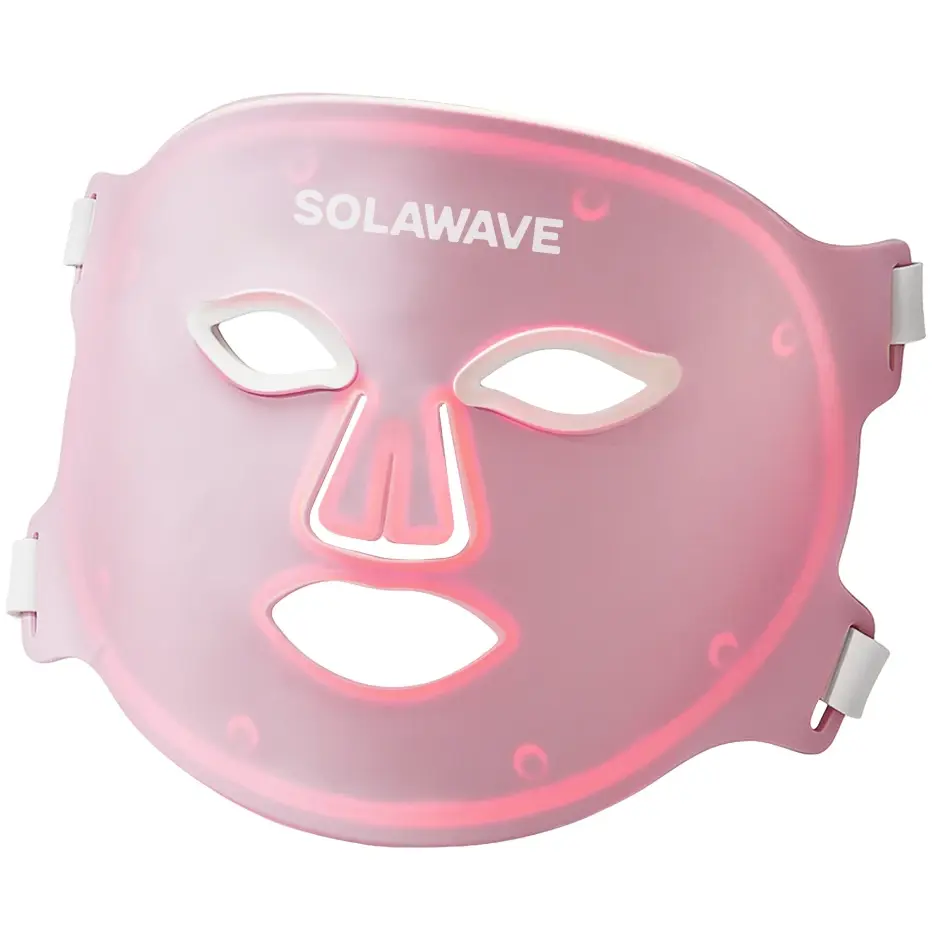
Solawave Wrinkle Retreat Pro LED Face Mask
The top pick in our 2026 rankings. It publishes both the wavelengths it uses and its irradiance at the treatment surface — the two specs that let you place a device against the published research rather than against marketing copy.
We earn a commission when you buy through links on this page, at no extra cost to you. Read our Affiliate Disclosure.
Published figures span roughly 10–100 mW/cm². Most dermatologic studies fall around 20–60.
Plotted on the 570–850nm band. Red is where most of the collagen-endpoint evidence sits.
Plotted on the same band. Near-infrared penetrates further and is used for deeper targets.
How red light works inside your skin.
The leading explanation is that specific wavelengths are absorbed by cytochrome c oxidase, a protein inside your cells' mitochondria involved in ATP production. Absorbing light appears to let it work more efficiently, giving cells more energy to repair tissue and produce collagen. Researchers in the field are careful to note the mechanism isn't fully settled.
Red light has also been associated with nitric oxide release and improved local circulation, and with increased procollagen in the fibroblasts that build the skin's structure. None of it involves injury — unlike lasers or peels, it gives cells an energy boost and lets them do the rest of the work.
The shortest of the three wavelengths, and the shallowest. Studied mainly for surface redness and uneven pigmentation.
Where most of the collagen-endpoint evidence sits — the wrinkle and procollagen trials use this band.
Penetrates further than visible red and is used for deeper targets. Above roughly 780 nm it is invisible to the eye.
Common myths, debunked by the research.
Red light therapy has a legitimate science base, but also a real misinformation problem — brands overpromising, critics overcorrecting. Here's what the evidence actually supports.
"It's just a marketing gimmick"
Photobiomodulation predates the wellness industry by decades — NASA funded research into LEDs for wound healing at Marshall Space Flight Center in the 1990s.
"All devices work the same"
Results depend on wavelength accuracy and irradiance together. A red light strong enough to raise chickens emits the right color but not a therapeutic dose.
"Results are immediate"
Cellular activity increases within a session, but visible changes follow the collagen cycle — 28 to 90 days of consistent use, at the two-to-three-times-a-week frequency the trials actually used.
"More LEDs means better results"
LED count isn't a reliable proxy for effectiveness. What matters is correct wavelength and enough irradiance at the skin's surface — not raw diode count.
Find the mask that actually works for your skin.
Red light therapy devices compared. One favorite. Our 2026 rankings are free to read — no sign-up required.